
Why is it that...
-
... some people strongly resist change while others actively seek it out?
-
... one person is convinced by facts and sound arguments, while another listens mostly to what their feelings are telling them?
-
... some people are goal-driven, while others seem to drift through life?
-
... some seem naturally optimistic, while others are more pessimistic by nature?
-
... some live for status and parties, while others are all about seriousness, structure, and rules?
-
... some people easily take the lead, while others are content to follow?
-
... some adapt effortlessly, while others cling to procedures?
-
... some are pushy and assertive, while others are self-sacrificing and accommodating?

What is DISC in a nutshell?
DISC is based on two key dimensions of behavior. So—what kind of engine is running under your hood?
First, DISC looks at pace. Some people like to move fast, speak with energy and confidence, and wear their heart on their sleeve. Others are more comfortable taking a calm and careful approach—more reserved, maybe even cautious. Think extrovert versus introvert, if you will.
Second, DISC explores priorities. What naturally feels important to you? What do you instinctively focus on in life?
These priorities act like the steering wheel of your behavior—pointing you toward either task or people orientation.
If you're task-focused, you're likely comfortable working independently and getting things done. If you're people-focused, you value relationships, emotions, warmth, and collaboration—you prefer doing things together.
It may sound simple, but most people can generally be described within four main behavioral styles.
And of course, everyone has their own unique blend.
-
Fast-paced and task-focused
-
Fast-paced and people-focused
-
Slower-paced and people-focused
-
Slower-paced and task-focused
-
Together, these form the DISC model.
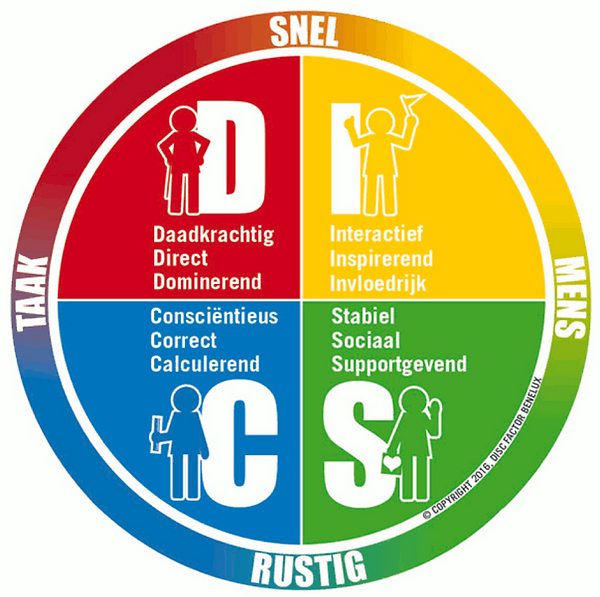
The 4 DISC styles
The letters of DISC stand for the four most important characteristics of behavior, also called personality styles. By 'personality' we mean the concretely observable behavior of people and the way they communicate.
No right or wrong
No style is better than another. Every style has strengths and challenges to work on. The beauty of DISC is that it places emphasis on a person's strengths.
Working, doing and being from your strengths and weaknesses is best done by recognising, learning to manage and having others who are strong in these areas complement each other.
Knowledge of the DISC Personality Analysis gives you the opportunity to understand yourself, but also your colleagues, customers, friends and family members in a good way.
Understanding personality styles helps you communicate better, avoid or reduce conflict, appreciate differences in others, gain trust, and positively influence others. In everyday life, you can observe personality styles in practice, because you come into contact with each style to a greater or lesser extent every day. When you think about your colleagues, customers, friends, and family members, you discover how the various personalities become visible before your eyes.
Completing the questionnaire is quick and easy.
The analysis consists of 96 statements. In blocks of four statements, you choose one statement that applies to you the most and one that applies to you the least. The result is neatly processed in a report.

What is DISC used for?
-
Building productive teams
-
Defusing frustration and resolving interpersonal conflict
-
Improving communication
-
Supporting team development and teambuilding
-
Deepening understanding of personality differences through recognition
-
Developing a powerful sales team
-
Enhancing customer service
-
A helpful tool for recruitment, job interviews, coaching, and career guidance
